Rare Disease Day: A Q&A with Stowers Investigator Jennifer Gerton
"We hope to provide insights into the basic molecular functions of these genes that can someday be harnessed to help people with mutations and their families."
29 February 2024
Which rare diseases does your lab study?
We study Cornelia de Lange Syndrome and Roberts Syndrome.
Cornelia de Lange Syndrome (CdLS) is characterized by slow growth of affected individuals before and after birth leading to short stature, intellectual disability that is usually moderate to severe, and abnormalities of bones in the arms, hands, and fingers.
Roberts Syndrome is a genetic disorder characterized by limb and facial abnormalities. Affected individuals also grow slowly before and after birth. Mild to severe intellectual impairment occurs in about half of all people with Roberts Syndrome.
How did you first become interested in your research related to these diseases?
We were already studying chromosome biology in budding yeast, and then studies were published that several genes we had been investigating (Nipbl, Esco) were mutated in CdLS and Roberts Syndrome. Studying these genes in research organisms allows us to understand what some of their fundamental functions are and how mutations disrupt these functions.
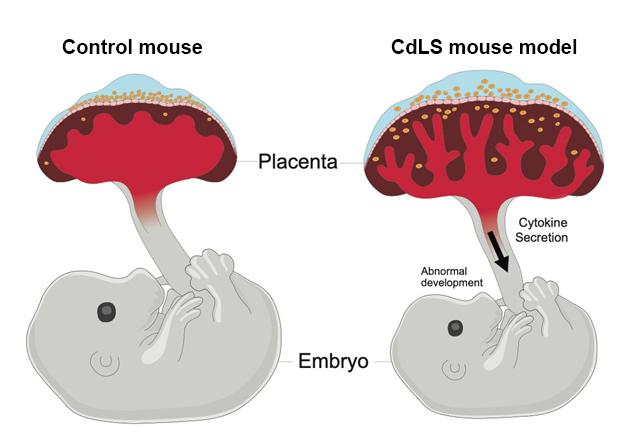
Research from the Gerton Lab has shown that in mouse models of Cornelia de Lange Syndrome, an abnormal placenta plays a previously unrecognized role during the earliest stages of development. (Illustration by Mark Miller)
Can you share an exciting discovery your lab has made in connection to these diseases?
One of our recent published studies by Vijay Singh revealed that Nipbl is important for the development of the mouse placenta, not just the development of the embryo.
What do you hope the impact of your team’s research surrounding these diseases will be in the future?
We hope to provide insights into the basic molecular functions of these genes that can someday be harnessed to help people with mutations and their families.