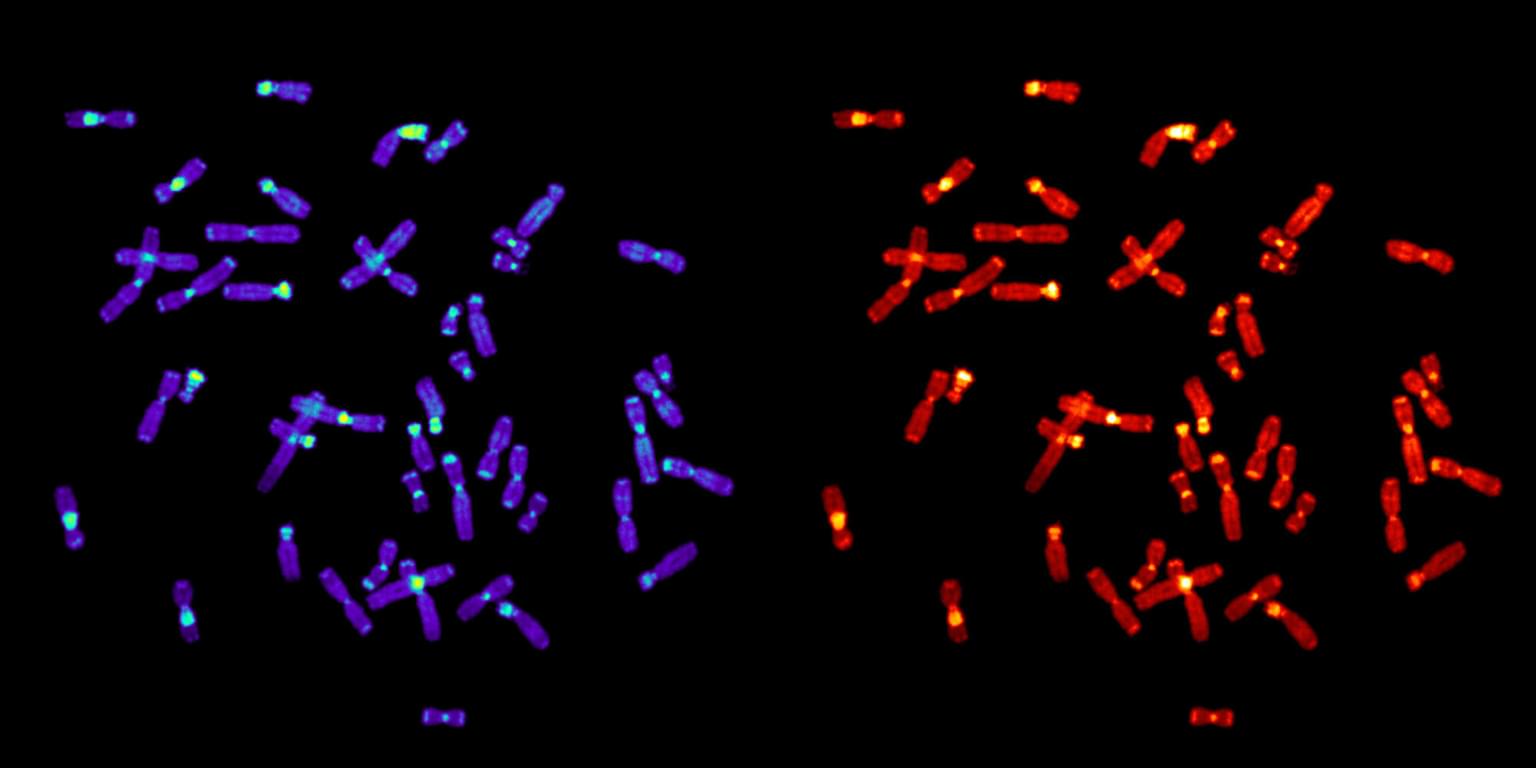
“This is the first time anyone has shown where this exact DNA breakpoint occurs,” said Jennifer Gerton, Ph.D., a lead author on the study and Stowers Institute Investigator and Dean of the Graduate School. “It opens the door to understanding how chromosomes evolve in a way that we had no appreciation for before.”
Carriers of Robertsonian chromosomes are often unaware they’re different. Although generally healthy, they can be infertile or suffer miscarriages. When they do have children, they’re at increased risk of having Down syndrome.
Now that Gerton’s team has revealed exactly how chromosomes fuse together and make Robertsonian chromosomes, scientists can better understand how to identify them and how they operate. “One day, we may be able to give carriers better genetic counseling and better options,” Gerton said.
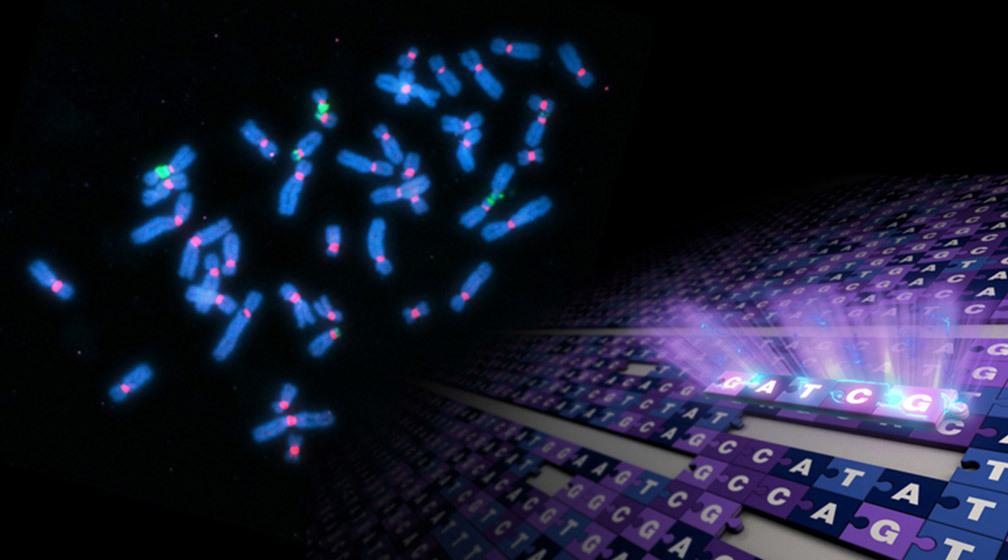
The team made use of a DNA sequencing technology called long read sequencing to produce the first ever complete sequences of Robertsonian chromosomes. Long-reads revolutionized the study of the human genome in 2022 by allowing scientists to read repetitive DNA sequences that tripped up older sequencing technologies.
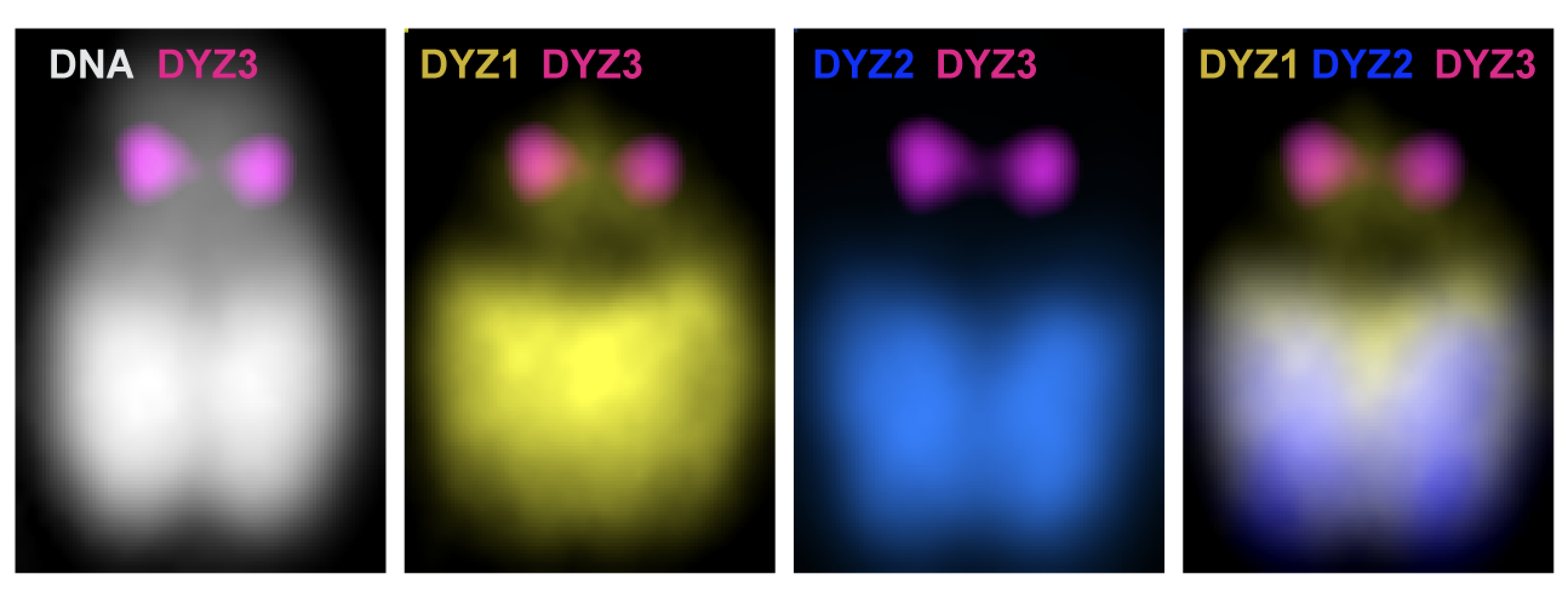
When the researchers compared the sequences of three human Robertsonian chromosomes to normal chromosomes, they found a common break point. The break point lies in a specific repetitive DNA sequence called SST1. “That’s never been shown before — in humans or in any other species,” said Gerton.
“This is a landmark study,” said genome scientist Glennis Logsdon, Ph.D., from the University of Pennsylvania, who was not involved in the work. “As the first group to identify the precise breakpoint at which Robertsonian chromosomes combine, Gerton and her colleagues have lit a flame that could ignite a broader understanding of how these chromosomes function,” she said, calling the development “exciting.”
“One of the joys of this project was bringing together three labs with complementary expertise,” Gerton added. The research was conducted in collaboration with Adam Philippy, Ph.D., at the National Human Genome Research Institute and Erik Garrison, Ph.D., at the University of Tennessee Health Science Center.
“Adam’s team is a world leader in assembling complex genomes, Eric’s group excels at studying variation across human populations, and our team specializes in repetitive DNA and chromosome biology,” Gerton said. “Together, we could tackle a question that none of us could have answered alone.”
The fusion formula
The team discovered highly repetitive DNA sequences called SST1s are where the breakpoints occur. They showed that when SST1 sites come together inside the nucleolus of a cell, their proximity can cause a merger that results in a Robertsonian chromosome.
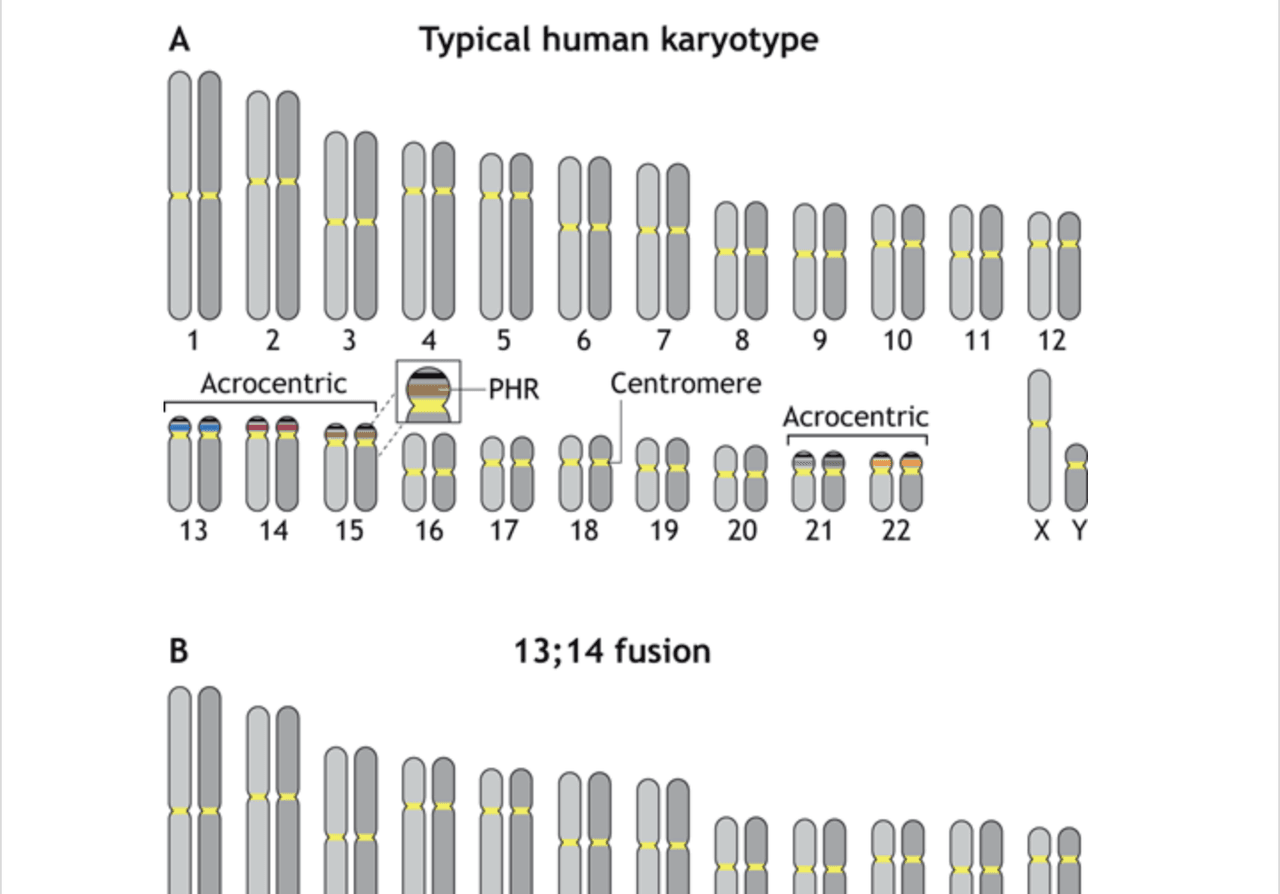
These repetitive DNA sequences are located near chromosome centromeres—the regions at their centers from which two arms extend. Of the 23 pairs of human chromosomes, five pairs—known as acrocentric chromosomes—have asymmetric arm lengths, one short and one long. The short arms are particularly difficult to sequence, and before 2022, they were missing from the complete sequence of the human genome. Armed with new technology, the team is now able to see what they couldn’t before.
“Robertsonian chromosomes form when two long arms fuse and the short arms are lost. That leaves 45 chromosomes instead of 46, and sometimes that doesn’t work very well — which can result in infertility," Gerton said.
The research reveals a key part of how Robertsonian chromosomes fuse is due to the orientation of the SST1 on chromosome 14. Its sequence is inverted or facing the opposite direction, allowing either chromosome 13 or 21 to attach. In both cases, the resulting Robertsonian chromosomes carry almost all the genetic material from both original chromosomes.
The team also showed why these fused chromosomes can remain stable. Although they carry two centromeres — the anchor point where chromosomes are pulled apart during cell division — only one is active. This prevents the fused chromosome from being pulled in opposite directions.
Looking across species
Robertsonian chromosomes are found in many kinds of animals and plants, and in fact they were first discovered in grasshoppers. Gerton said, “Now that we know how these chromosome form in humans, it gives us insight into how they occur broadly in nature.” In some cases, the specific Robertsonian arrangement carried by an animal limits which other animals it can reproduce with. The common house mouse, for example, has the best chance of having offspring when it mates with others carrying the same arrangements.
When Gerton and her colleagues looked at the genomes of humans’ closest living relatives, chimpanzees and bonobo monkeys, they saw some distinct differences from humans. The great apes still had the SST1 sequences that drive Robertsonian chromosome formation, but their arrangement was slightly different, making this finding unique to humans.
It seems possible that the arrangement of repetitive DNA sequences within genomes are a part of what makes each species distinct, Gomes de Lima said. “It really got us thinking about the role these repetitive DNA sequences play in shaping the genome and potentially creating new species.” Gerton added, “It’s clear that there’s a story there, and that’s what we plan to study next.”
Additional authors include Andrea Guarracino, Ph.D., Sergey Koren, Ph.D., Tamara Potapova, Ph.D., Sean McKinney, Ph.D., Arang Rhie, Ph.D., Steven Solar, M.D., Chris Seidel, Ph.D., Brandon Fagen, Brian Walenz, Gerard Bouffard, Ph.D., Shelise Brooks, Michael Peterson, Kate Hall, Juyun Crawford, Alice Young, Ph.D., Brandon Pickett, Ph.D., Erik Garrison, Ph.D., and Adam Phillippy, Ph.D.
This work was funded by the National Cancer Institute of the National Institutes for Health (NIH) (award: R01CA266339), the National Human Genome Research Institute of the NIH (award: R01HG013017), the National Institute on Drug Abuse of the NIH (award: U01DA057530), the Division of Computing and Communication Research of the National Science Foundation (award: 2118743), the Intramural Research Program of the Nation Human Genome Research Institute of the NIH, the State of Tennessee’s Center for Integrative and Translational Genomics, and with institutional support from the Stowers Institute for Medical Research. The content is solely the responsibility of the authors and does not necessarily represent the official views of the NIH.
About the Stowers Institute for Medical Research
Founded in 1994 through the generosity of Jim Stowers, founder of American Century Investments, and his wife, Virginia, the Stowers Institute for Medical Research is a non-profit, biomedical research organization with a focus on foundational research. Its mission is to expand our understanding of the secrets of life and improve life’s quality through innovative approaches to the causes, treatment, and prevention of diseases.
The Institute consists of 20 independent research programs. Of the approximately 500 members, over 370 are scientific staff that include principal investigators, technology center directors, postdoctoral scientists, graduate students, and technical support staff. Learn more about the Institute at www.stowers.org and about its graduate program at www.stowers.org/gradschool.
Media Contact:
Joe Chiodo, Director of Communications
724.462.8529
press@stowers.org