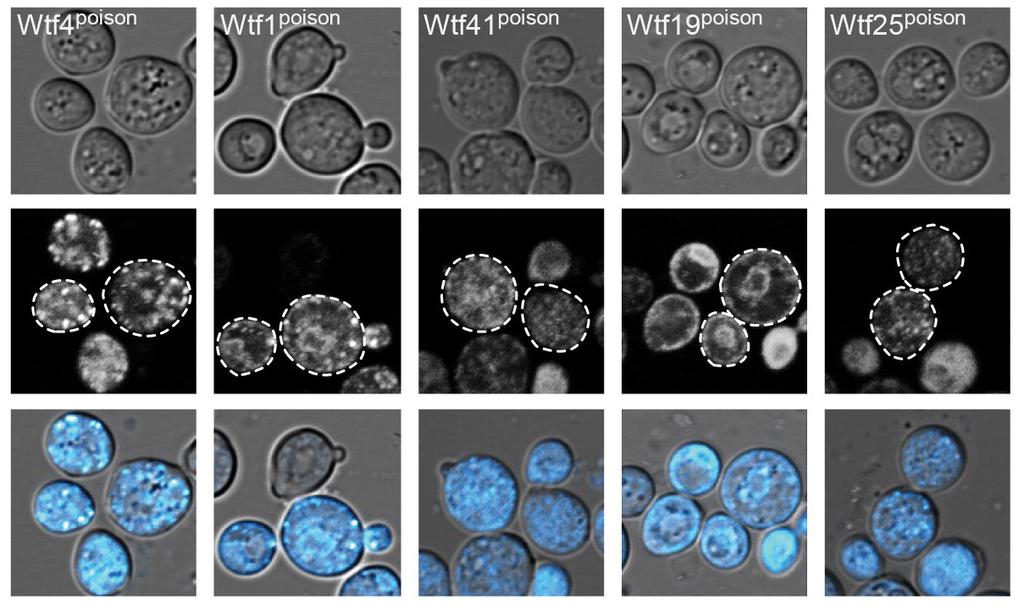
This research expands on a previous study describing how one wtf gene (wtf4) is passed on from generation to generation. The current study, led by Predoctoral Researcher Ananya Srinivasa Nidamangala from the Zanders Lab, explored whether all functional wtf genes—there are hundreds—rely on similar molecular mechanisms and which protein features were necessary for function.
Several key discoveries emerged. The killing ability of wtf genes originates from the way Wtf poison proteins aggregate or form clusters. Their matching antidotes also cluster together, and the poison and antidote must co-assemble to rescue developing gametes, or reproductive cells. These self-assembly properties resemble those of other proteins capable of forming toxic clusters, such as those implicated in neurodegenerative diseases.
“Proteins that self-assemble into aggregates play important cellular roles but are also linked to diseases like Alzheimer’s,” said Zanders. “Our work adds to our understanding of fundamental biological questions—which protein sequences favor aggregation and what distinguishes aggregates as toxic or non-toxic.”
Size matters. So does location.
The teams used the Schizosaccharomyces kambucha yeast isolate, isolated from the effervescent beverage, kombucha, as a system to study Wtf protein properties. Proteins were measured with DAmFRET, a technique developed in the Halfmann Lab that detects aggregation. The researchers discovered that all functional wtf genes share the Wtf4 proteins’ self-assembly capabilities, a surprising finding given the extreme variability of the genes’ sequences and the proteins they make.
The researchers then assessed what makes proteins toxic. They designed mutant Wtf poison proteins to alter aggregate size and their distribution within cells. Larger clusters were less toxic than smaller ones, and global distribution within cells was required for killing.
“Our findings strongly implicate aggregation and protein localization as key factors for toxicity,” said Zanders.
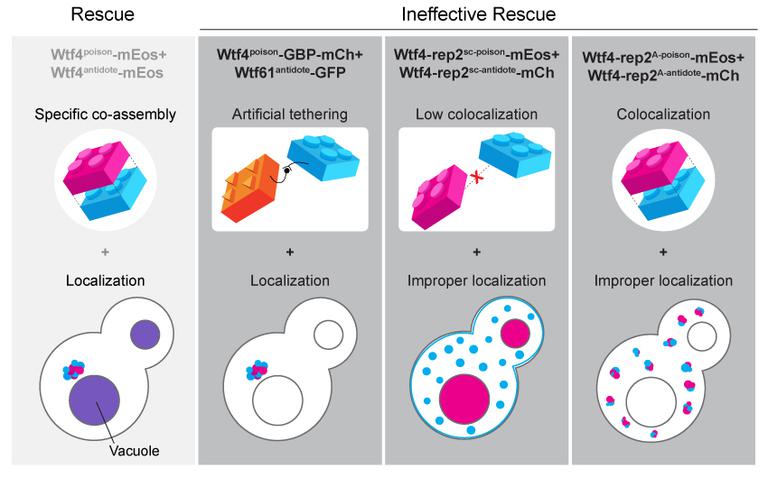
The antidote protein was known to transport poison protein clumps to the vacuole, a cell’s version of a trashcan, for disassembly and disposal. Previously, researchers thought that the poison-antidote cluster simply served as a tether. Now, the researchers found that a specific poison-antidote co-assembly, which increases aggregate size and isolates it, is necessary for neutralization. Zanders explained that “just sticking the proteins together is insufficient.”
“This work is confirming an emerging paradigm underlying toxicity—aggregate size and distribution within a cell matters,” said Halfmann. “Our lab focuses on how proteins self-assemble, particularly those involved in neurodegenerative diseases. By applying our knowledge and tools to the poison-antidote mechanisms in yeast meiotic drive genes, we could see clear parallels of what makes self-assembling proteins toxic and more importantly how they can be detoxified.”
An evolutionary arms race
The dynamic interplay of sabotage and salvation lends an almost cinematic touch to yeast’s evolutionary plot. The rapid evolution of wtf drivers have enabled them to outrun suppressor genetic elements for over 100 million years. However, the researchers found that mutations can and do occur in nature, giving rise to “self-killing” gene copies that totally destroy fertility of organisms carrying the gene.
“We demonstrate that crazy different Wtf protein sequences can all somehow make aggregates. Evolution goes with what works, and this job of efficient killing works,” said Zanders. “The striking thing to me is how these super different proteins all execute this same task, and that's something that we'll continue to explore going forward.”
“A major driver of rapid genome evolution are genetic conflicts,” Zanders further explained. “Understanding the conflicts introduced by wtf genes is shedding light on fission yeast genome evolution, but similar dynamics, similar arms races, similar conflicts are happening throughout other organisms and have shaped our own genomes as well. This study opens the door for future research into how protein aggregation influences infertility, evolution, and disease.”
Additional authors include Samuel Campbell, Shriram Venkatesan, Ph.D., Nicole Nuckolls, Ph.D., and Jeffery Lange, Ph.D.
This work was funded by the National Institute of General Medical Sciences of the National Institutes of Health (NIH) (awards: R35 GM151982-01, DP2 GM132936), the Eunice Kennedy Shriver National Institute of Child Health & Human Development of the NIH (award: F31HD097974), and with institutional support from the Stowers Institute for Medical Research. The content is solely the responsibility of the authors and does not necessarily represent the official views of the NIH.
About the Stowers Institute for Medical Research
Founded in 1994 through the generosity of Jim Stowers, founder of American Century Investments, and his wife, Virginia, the Stowers Institute for Medical Research is a non-profit, biomedical research organization with a focus on foundational research. Its mission is to expand our understanding of the secrets of life and improve life’s quality through innovative approaches to the causes, treatment, and prevention of diseases.
The Institute consists of 20 independent research programs. Of the approximately 500 members, over 370 are scientific staff that include principal investigators, technology center directors, postdoctoral scientists, graduate students, and technical support staff. Learn more about the Institute at www.stowers.org and about its graduate program at www.stowers.org/gradschool.
Media Contact:
Joe Chiodo, Head of Media Relations
724.462.8529
press@stowers.org