In The News


28 May 2026
RegVelo AI Predicts Cell Fate and Key Genes
From The Chosun Daily, research from the Sauka-Spengler Lab – RegVelo aids regenerative medicine, cancer research by identifying gene drivers.
Read Article
News
The Sauka-Spengler Lab explores the blueprint and circuitry driving cells
If your body were a city and genes were blueprints for buildings, you would still need architects, engineers, city planners, and construction workers to erect and maintain the city’s structures. In essence, the combination of blueprints, construction, and maintenance are akin to gene regulatory networks.
Every cell has a complete set of genetic instructions, or blueprints for roughly 20,000 genes in its nucleus. However, only certain genes are active, and these determine the cell’s function. How certain genes are activated and inactivated by other genes, proteins, and DNA sequences through an intricate system of connections is called a gene regulatory network. “Genes don’t work in isolation,” said Julianna Haug, a researcher in the lab of Stowers Institute Investigator Tatjana Sauka-Spengler, Ph.D. “They need a control system that decides when to turn on or off and by how much.”
These networks function like an electrical grid, ensuring genes operate smoothly. Proteins and small RNA molecules act as switches, regulatory connections serve as wires, and master regulators function like circuit breakers that trigger molecular cascades.
The Sauka-Spengler Lab explores these networks in research related to development and regeneration. “We think of gene regulatory networks like electronic circuits,” Sauka-Spengler explained. “Thousands of molecules exist in a cell, but not all are active at once. There is a hierarchy of networks and large but definable sets of interactions between them, making it a solvable system.”
Gene regulatory networks are crucial for responding to environmental changes, coordinating tissue and organ formation, and assisting in bodily repair. “If these networks are disrupted, it can result in power outages—or in the body, diseases like cancer, diabetes, and genetic disorders,” said Haug.
By studying these networks, researchers can gain deeper insights into diseases and develop new treatments—just as understanding a city’s power grid helps engineers fix outages.
Explore more topics explained in our #BioBasics series here.
In The News
28 May 2026
From The Chosun Daily, research from the Sauka-Spengler Lab – RegVelo aids regenerative medicine, cancer research by identifying gene drivers.
Read Article
In The News


12 May 2026
From Brighter Side of News, research from the Sauka-Spengler Lab, RegVelo combines RNA velocity and gene networks to predict how cells choose identities and react to genetic disruption.
Read Article
Press Release

11 May 2026
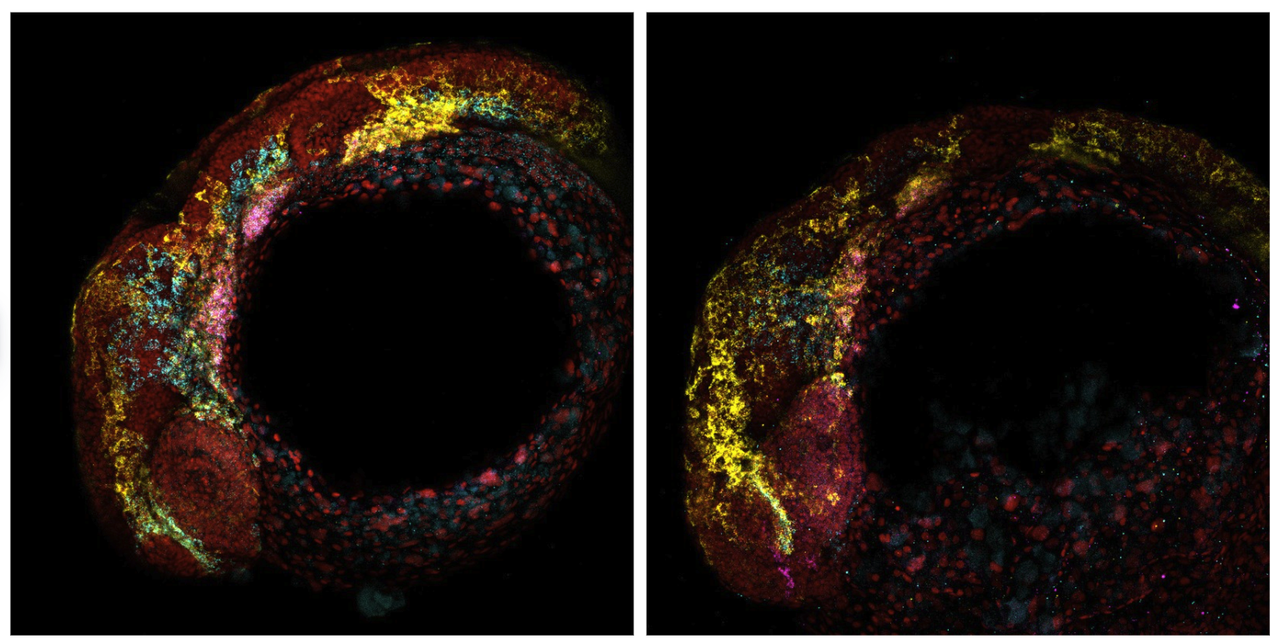
RegVelo, a new AI technology developed by Stowers Institute and Helmholtz Munich scientists, allows researchers to predict not only how cells acquire their identities, but what path they take and what drives them there — with implications for developmental disorders, tumor growth, and regenerative medicine.
Read Article
Press Release
11 May 2026
RegVelo, a new AI technology developed by Stowers Institute and Helmholtz Munich scientists, allows researchers to predict not only how cells acquire their identities, but what path they take and what drives them there — with implications for developmental disorders, tumor growth, and regenerative medicine.
Read Article